Karl Rahner’s Christology from Below
Rahner’s Life
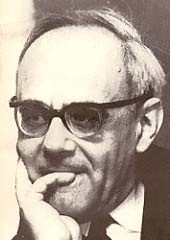
Karl Rahner was born in Bavaria in 1904 to a middle-class Catholic family and joined the Society of Jesus at 18. He studied, taught and wrote about theology as a Jesuit priest until his death in 1984 aged 80. Despite an outwardly uneventful life, he was probably the most influential Catholic theologian of the 20th century.
He was brought up at a time when Pope Leo XIII had declared the philosophy and theology of Thomas Aquinas to be the official theology of the Catholic Church, and he was trained in the narrow authoritarian interpretation of the Thomist system that had been developed by the mediaeval scholastics and was prevalent before the Second Vatican Council. He was recognised from an early age as a deep and original thinker, who accepted the Thomist inheritance but interpreted it in the light of modern philosophers, such as Martin Heidegger and Immanuel Kant. His massive doctoral thesis, later published as Spirit in the World, was rejected by Freiburg University as too radical. After his early philosophical publications, Rome started to take an interest: he was forbidden to publish his book on the Assumption in 1950, and in 1960 Cardinal Ottaviani directed that he must publish nothing until it had been read and approved by a Vatican censor. In 1965 he was invited to take part in the Second Vatican Council as a peritus, or expert advisor, and some would say that he was one of the most important influences in shaping its outcomes.
Unlike some of his contemporaries, Rahner never rejected the defined dogmas of the Church but always sought to reinterpret their true meaning in the light of human experience and culture, to maintain continuity with the historical teaching of the Church while making it relevant to our everyday life. The quite original central ideas which he developed underlie all that he wrote, but very few of his many publications demonstrate the overall structure of his thinking. For example, the 23 volumes of his Theological Investigations are a collection of essays on an extremely wide range of subjects, from angels to nuclear weapons, from the experience of God to the history of the sacrament of penance, in no particular order. Though I shall be talking mainly about his academic theology, which does not make for easy reading, he wrote extensively also on practical pastoral issues and on spirituality and prayer, based on his own deep Ignatian spirituality.
Transcendental experience
Karl Rahner’s theology starts from his understanding of the nature of human beings. What does it mean to be a man (or woman)? The definitions given by Aristotle, a ‘rational animal’ or a ‘social animal’, do not get us very far. What are ‘rationality’ and ‘sociability’? – not just the ability to solve logical problems and to live in cities or structured societies. He sees human beings as essentially reaching beyond the limits of the here and now, of the things we can see and touch and manipulate and sort into categories and express in our concepts – what he calls our ‘categorial’ experience of the world, by which we live our everyday lives. We can go beyond or transcend our finite lives by seeking something out of our grasp, over the horizon. For instance, if I ask a question and answer it, I can go on and ask further questions, without ever reaching an end beyond which there are no more questions; however much I love, I can always love more deeply and more completely – I can never reach a point at which I can say, ‘I can love no more’. Indeed every ‘categorial’ experience, every day-to-day involvement with particular people and places and things, is coloured by our ‘transcendental’ experience of knowing that there is something beyond that and of wanting to get closer to that unknown something, even though we may not be conscious of this transcendental experience at the time, much less be able to describe it. We have a built-in dynamism towards a Truth and a Love we can never fully attain. This is, for Rahner, what makes human beings truly human.
God’s Self-revelation
That unknown (and ultimately unknowable) ‘something’, towards which we and all human beings are orientated, is, of course, God. Our dim awareness that there is something beyond the finite world, or our vague dissatisfaction with our own limitations, is God revealing himself to us. This self-revelation (or self-communication) of God is what in traditional theology is called ‘grace’. It is constantly being given to every human being in everything he or she does, whether or not it is recognised and used. Another metaphor Rahner uses is to liken our everyday life to seeing things around us, reading books, avoiding obstacles when we walk, all of which is possible because there is light, and the light, which we do not ‘see’ or bump into in the same way, is God’s grace.
This transcendental experience is not, of course, the only way God reveals himself to people, though it is the most universally available. For example, he reveals himself in the history and culture of the Jewish nation, recorded in the Bible, and particularly in the life, teaching, death and resurrection of Jesus, and his impact on his disciples, recorded in the New Testament.
Since we are designed as human beings to seek and respond to God’s outreach, it follows that, the more we do so and the more we inch closer to that infinite unattainable goal, which is God, the more we realize our potential as human beings – the nearer we come to being perfect men and women. The way that we do it is to empty ourselves of ‘self’ so that we are filled with the spirit of God, and become more united to him. We all have some experience of God simply by having a built-in orientation to him, but for most people it is ‘unthematic’ as Rahner puts it – felt in different ways by different people and not recognized or described as an experience, much less a Christian one. Insofar as people do respond to it positively, they can become truly devoted to God, according to Rahner, without necessarily recognizing the relevance of the historical Jesus Christ.
Jesus Christ
The Church teaches that Christ is both God and man, and that he has a divine nature and a human nature which are quite separate from each other ‘without confusion or change’[1]. Traditional theology says that God, and therefore Christ in his divine nature, is absolutely unchanging, or immutable. It follows that, when the gospel tells us ‘the Word became flesh’[2], all the becoming and change were in his human nature; as Rahner says, ‘all becoming and all history and all the laborious effort connected with them still remain on this side of the absolute abyss which separates the immutable, necessary God from the mutable, conditional and historical world in its process of becoming, and which admits of no admixture between them’[3].
Jesus of Nazareth was created a man, ‘like unto us in all things but sin’[4]. He was not born with any ‘superhuman’ powers, such as the ability to solve differential equations or to speak English. He learned to form relationships, read, write and pray, and he no doubt made mistakes in the process, as we do. But in all that he did he accepted and was obedient to God’s self-communication; as he grew and matured as a man, his union with God became complete. At some time between his birth and his death, he fully realized his human potential, so that he and the Father were one, each living in the other[5]. At that point, we may say, his human nature and his divine nature were united in the one person of Jesus Christ. It happened only once in history (and could happen only once, as I shall try to explain shortly). This is what I mean by saying, ‘Jesus Christ was the man who became God’.
God’s self-communication is present in every human being, at least as an offer of God himself. To the extent that the offer is taken up, God gives himself to that person. Jesus accepted this offer wholly and unconditionally, and so God gave himself fully and completely to Jesus. Before Jesus, God’s offer of himself to mankind, which had been implicit in the creation of the world, was conditional on someone accepting it fully. Once someone had accepted it fully, it became unconditional and irreversible – a gift not just to that individual but to the human race. God’s relationship to mankind and to the created world changed forever. Jesus became God’s definitive promise of himself, and became thereby the Saviour or Redeemer of the human race. Other people after him might accept God’s offer and even become united to God (in traditional theological language, ‘enjoy the beatific vision’); but they could never play the part in the salvation of the world that Jesus played, because that had already been done once and for all.
Searching, Ascending and Descending Christologies
Christology is the branch of theology that seeks to give an account of what we can know about Christ. Different true accounts are possible, and so different equally valid christologies may co-exist, looking at the same truth from different viewpoints. Rahner was very concerned that many people of good will were searching for the meaning of their existence, fulfilment, or, as he defined it, salvation. They may search unsuccessfully for the meaning of life in the details of their own lives, in the possibilities of worldly pleasures or achievements. They may search for this meaning in mysticism or a philosophical theory, which would take them away from practical engagement with people and things in the concrete historical world we live in. Or they may decide that they can express their freedom and work out their salvation only in association with their environment, their fellow human beings and, in effect, history. In that case they may look for another human being in whom salvation has been really successful and is capable of being experienced by them. Such a person, if he exists, can be called the absolute bringer of salvation, because he promises us salvation as a firm hope. According to Rahner, people who seek such a Saviour with honesty and determination are already practising a ‘searching Christology’[6].
The Saviour they are looking for is, we know, Jesus of Nazareth. When someone arrives at a belief that Jesus Christ is, in his whole life up to and including his death, and in his victory over death which we call his ‘resurrection’, the definitive, unsurpassable and victorious offer of salvation to human beings by God, then the christology that follows from such a realization is what Rahner calls, in different places, a ‘saving history christology’, or an ‘ascending christology’ or (more simply) a ‘christology from below’. This is an account of Christ that starts from human experience and from Christ the man, as I have already indicated. Rahner has outlined its basis and some of its implications in far more detail than I have, but it will need much more work by theologians to develop it to anything like the extent of the traditional Christology, which he called ‘metaphysical christology’, or ‘descending christology’ or ‘christology from above’.
The ‘christology from above’ starts from the three persons in God as something given. It then says that one of these persons, the Son, the Word of God, came down from heaven to earth and assumed a human nature. As a man, he died to redeem us from sin, rose again, and then returned to heaven. Rahner does not for one minute dispute the truth of the traditional formulas of Christian belief, but he believes that the terms in which they are expressed (which may have been appropriate when they were first formulated) are thoroughly misleading for people today. For example, it is almost inevitable that when you hear ‘three persons’ you will draw on the normal meaning of ‘person’ in every other context and think of three separate centres of consciousness and activity. But this is an absolutely incorrect understanding of the Trinity.
Rahner criticises what he calls ‘the psychological theory of the Trinity’ (developed out of St Augustine’s account) as an almost heretical speculation on the inner life of God in terms of the love between the three persons, which has no basis in our human experience of God working in the world[7]. (How often do we hear popes, bishops and priests telling us we should model our human relationships on the relationships within the Trinity![8]) The Father, Son and Spirit are three distinct modes in which the one God is present for us in this world. The psychological model does not explain satisfactorily what it is supposed to explain – why the Father expresses himself in the Word and, with the Word, breathes out a Spirit which is different from him; nor does it help us to understand from our actual experience of the Son and the Spirit in salvation history what the doctrine of the Trinity really means. But his main criticism of the ‘christology from above’, as it is usually expressed, is the risk that it will lead people into one of the earliest heresies in the history of the Church, that of Docetism (from the Greek dokein, ‘to seem’). This is the idea that God merely disguised himself as a man or, in order to be visibly acting in the world used a human nature in a way that was not a real man with independence and freedom but a sort of puppet on a string. Rahner thinks that such a mythological idea of the Christian doctrine of the Incarnation may be implicit in the thinking of many Christians who consider themselves wholly orthodox in their beliefs[9]. And non-Christians who wrongly think that this is Christian doctrine may be led to reject the Incarnation as a myth.
‘Anonymous Christians’
To finish, I would like to return briefly to those honest searchers after fulfilment or salvation who have not yet found it in the historical Jesus. As I’ve said, everyone has a built-in orientation towards realizing their potential, that is, towards fulfilment or salvation. To the extent that a person responds to that orientation, and obeys God’s call to accept his gift of himself, he or she forms (perhaps unknowingly) a personal relationship with Christ. In Rahner’s words, that person ‘exercises this obedience by accepting his own existence without reservation, and indeed precisely in those areas where freedom risks something which cannot be calculated or controlled’[10]. Rahner gives three examples of how such a person could be united with Christ.
Firstly: no finite and unreliable human being can ever justify the absolute and unconditional love of another person. If, therefore, one person loves another with such a love, a love in which the lover ‘involves’ and risks himself (or herself) without reservation for the other, then, taking Matthew Chapter 25 seriously (‘insofar as you did this to one of the least of these brothers of mine, you did it to me’), the lover is loving Christ, and such a love is searching for a God-Man deserving of such absolute love, not just as an idea but as a reality.
Secondly, if a free human being accepts fully and readily the radical powerlessness implicit in his own death, without denial or protest, then that person is sharing in Christ’s own victory over death.
Thirdly, we all go forward to meet the future in hope, both making plans and opening ourselves to the unforeseeable, constantly trying to reduce the distance between what we are and what we should be and want to be. This works both at the level of the individual person and for the human race as a whole. If someone really hopes and trusts that he has within himself the capacity to reach the goal of perfecting himself (which we describe as uniting himself with God), and if also he believes that the whole world can, and one day will, be united so that all conflicts are reconciled and all its imperfections removed, then that person shares the Christian hope implied by the Incarnation and Resurrection of Jesus Christ.[11]
In an unfortunate and much-criticized phrase, Rahner refers to such people, who have responded to God’s call without recognizing Jesus of Nazareth or the Christian religion as relevant to them, as ‘anonymous Christians’ and to their unwitting union with Christ as ‘anonymous Christianity’[12]. They may well include devout Muslims or Hindus or members of other religions who are convinced that Christianity is false and who would therefore vehemently reject such a description of themselves. He argues that the ‘anonymous Christians’ can come to salvation in some way through the Church and can belong to it, without being visibly or knowingly part of the Catholic Church as an institution. The arguments by which he reaches this conclusion, and many other aspects of his theology, are beyond the scope of this introduction.
Trailer for next session
Every Sunday I stand up in church and say that I believe in one Lord Jesus Christ, and ‘Through him all things were made’. In saying this I have often wondered how a first-century Palestinian Jew could be said to have had any part in the creation of the universe, an event which happened (or started to happen) some 14 billion years before he was born. Whilst I do not expect us in an hour or so to get to the bottom of one of the most puzzling aspects of the Christian faith, I believe our understanding can be helped by looking at how a third-century theologian, often called ‘the father of systematic theology’ approached the issue by examining the text of St John’s gospel. The last two discussions have focussed on the man Jesus. We now turn to the Word of God, and Origen’s view of what some people have called ‘the cosmic Christ’.
Notes:
[1] Symbol of Chalcedon in The Christian Faith, ed. Neuner and Dupuis no 615, p 154
[2] Jn 1: 14.
[3] Foundations of Christian Faith, K Rahner tr. W V Dych, (NY: Crossroad, 1998), p 220.
[4] Symbol of Chalcedon in The Christian Faith, no 614, p 154, quoting Heb.4: 15.
[5] cf Jn 10: 30, 38.
[6] cf A New Christology, K Rahner and W Thüsing, (London: Burns & Oates, 1980), pp 5-6.
[7] Foundations of Christian Faith, p 135
[8] cf for example Archbishop Bernard Longley’s Pastoral Letter to be read in Birmingham Diocese on 29/30 December 2012, paragraph 3; The Common Good, Catholic Bishops’ Conference of England & Wales, (1996) n 18, p 7; Caritas in Veritate, Pope Benedict XVI, (2010), n 54.
[9] cf ‘On the Theology of the Incarnation’, Theological Investigations Vol IV, K Rahner, (London: Darton, Longman and Todd, 1966), p 118.
[10] Foundations of Christian Faith, p 306.
[11] see Foundations of Christian Faith, pp 295-298.
[12] ‘anonym’ is a technical term from the philosophy of Martin Heidegger. It might have been clearer to use the descriptions ‘unwitting Christian’ and ‘unwitting Christianity’ (‘unbewußt Christ’, ‘unbewußte Christentum’)
Select Bibliography
Books by Karl Rahner (translated into English)
Theological Investigations Volumes I to XXIII (London, Darton, Longman & Todd, various dates). His most extensive collection of writings on a wide range of subjects. A few volumes can be picked up second-hand, but generally hard to find outside theology libraries. However, all 23 volumes are available as a searchable PDF (at £60) from The Way (www.theway.org.uk). Essays particularly relevant to this discussion include:
‘Current Problems in Christology’, (Vol I, 1961), pp 149-200.
‘The Eternal Significance of the Humanity of Jesus for Our Relationship with God’, (Vol III, 1967), pp 35-46.
‘On the Theology of the Incarnation’, (Vol IV, 1966), pp 105-120.
‘Christology within an Evolutionary View of the World’, (Vol V, 1966), pp 157-192.
‘One Mediator and Many Mediations’, (Vol IX, 1972), pp 169-194.
‘The Two Basic Types of Christology’, (Vol XIII, 1975), pp 213-223.
‘Jesus Christ – the Meaning of Life’, (Vol XXI, 1988), pp 208-219.
‘Christology Today’, (Vol XXI, 1988), pp 220-227.
Foundations of Christian Faith – An Introduction to the Idea of Christianity, tr William V Dych, (NY, Crossroad, 1978). A brilliant and full exposition of his systematic theology, but its 970 pages are not an easy read for the beginner. As one review put it, ‘the theologically and intellectually alert will find this a volume of incomparable pleasure’.
A New Christology, by Karl Rahner and Wilhelm Thüsing, (London, Burns & Oates, 1980). Rahner wrote the first 40 pages of this book, and Thüsing, a biblical scholar, looks for biblical support for Rahner’s theology in the remaining 200-odd pages.
Christian at the Crossroads, (London, Burns & Oates, 1975). Fourteen essays (extracted from a slightly longer German work), five on his fundamental theology (‘What is man?’, ‘Why am I a Christian?’, etc) and nine on various aspects of Christian practice ( e.g., ‘Is prayer dialogue with God?’, ‘Penance and confession’), which are written for the layman and constitute quite a good introduction to Rahner. They do not address the issue of the ‘ascending christology’.
Our Christian Faith, by Karl Rahner and Karl-Heinz Weger, (London, Burns & Oates, 1980). A slightly more systematic examination of the main tenets of Christian belief as they affect people faced with the problems of contemporary life, in the form of nine questions and answers plus a concluding essay. Again, it does not address directly the question of christologies.
An Encyclopedia of Theology – the Concise Sacramentum Mundi, ed by K Rahner, who provided 85 of the entries, (NY, Seabury, 1975). A useful reference work, abridged from the six-volume ‘Sacramentum Mundi – An Encyclopedia of Theology’ (NY, Herder & Herder, 1968-70) of which Rahner was one of the editors.
Books about Rahner’s Theology
Karl Rahner, by Karen Kilby, (London, Fount Paperbacks, 1997). An excellent short (80 pages) introduction to Rahner’s thought, in the Fount Christian Thinkers series. It does not deal with the issue of his ‘ascending christology’.
The Cambridge Companion to Karl Rahner, edd D Marmion and M Hines, (Cambridge, Cambridge University Press, 2006). 20 chapters by different authors on aspects of Rahner’s theology and especially on how it relates to current theological concerns, with suggestions for further reading.
 Goodness Gracious