Origen’s Approach to the Word of God
Origen’s Life and Legacy
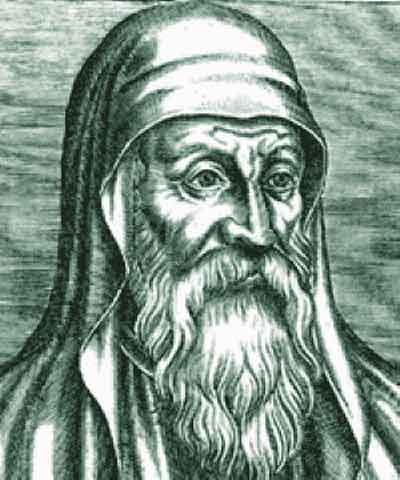
Ōrigenes Adamantius, generally known in English as Origen, was born about 185 AD in Alexandria, the capital of Egypt, a thriving commercial city and a great centre of learning in the Roman world. When he was 17 his father, a professor of literature and a Christian, was beheaded in the persecution of the Church by the Emperor Septimius Sevērus. Origen was appointed a catechist (or teacher of religion) by Bishop Demetrios of Alexandria, and studied philosophy and scripture, while living extremely simply. His fame as a theologian increased, he began to travel abroad, and spent some time in Palestine where the local bishops asked him to preach in their churches. The bishop of Alexandria was furious to hear that a layman was preaching in church and ordered him home. In the next few years he wrote his first major book, On First Principles, the first ever handbook of Christian systematic theology, and started his great Commentary on the Gospel of St John. He fell out with Bishop Demetrios and left Alexandria for good to settle in Caesarea in Palestine, where he was ordained priest and given full authority to preach. During his life he published an enormous number of books, sermons and letters. A hundred years later, Eusebius listed 2,000 treatises plus 9 books of letters, and Epiphanius estimated Origen’s output at 6,000 separate works. When Origen was 65, the Emperor Dĕcius began a pogrom against Christian intellectuals; Origen was arrested and tortured continually on the rack to try to get him to recant his Christianity. After Decius’ own assassination two years later, Origen was released and survived as an invalid for two more years. So when he died at 69, he was not recognized as a martyr by the Church. If he had been, a lot of what followed might never have occurred.
After his death, Origen’s theology was always controversial, and sparked two major attacks – one at the end of the fourth century and another in the sixth century. Many of the arguments used, both by his opponents and by his supporters, were based on misunderstandings of his teachings, and were caught up in political battles between the Roman imperial establishment and various monastic communities who claimed Origen as their champion. In 543 the Emperor Justinian decreed that all his books should be burned, and in 553 the Council of Constantinople, convened by the Emperor while the Pope (then held as a hostage by the Emperor) refused to attend, condemned a list of heretics and included Origen’s name on that list. As a consequence, almost all of his work has been destroyed or lost, and Catholics have been forbidden to read him for most of the past 1,500 years. We have fairly complete texts of half a dozen of his books and fragments of a few more.
I am glad to say that his worth has begun to be recognized by the Catholic Church in the last 50 years or so. Pope Benedict XVI said of him:
In our meditations on the great figures of the early Church, today we become acquainted with one of the most remarkable. Origen of Alexandria truly was a figure crucial to the whole development of Christian thought. … This great teacher of the faith was highly esteemed by his students not only for his theological brilliance, but also for his exemplary moral conduct. His father, Leonides, was martyred during the reign of Septimius Severus. Though Origen himself always had a deep yearning to die a martyr’s death, he decided that the best way to honour his father and glorify Christ was by living a good and upright life. Later, under the Emperor Decius, he was arrested and tortured for his faith, dying a few years later. Origen is best known for his unique contribution to theology: an “irreversible turn” which grounded theology in Scripture. He emphasized an allegorical and spiritual reading of the word of God, and demonstrated how the three levels of meaning – the literal, the moral, and the spiritual – progressively lead us to a deeper prayer life and closer relationship with God. Origen teaches us that when we meditate on God’s word and conform our lives to it, we allow the Holy Spirit to guide us to the fullness of truth. May we follow Origen’s example by praying with scripture, always listening attentively to God’s word.[1]
The ‘Cosmic Christ’
Origen addressed a wide range of theological questions in a creative and original way and, as might be expected, not all his ideas stood the test of time. I want to say a few words about what is sometimes called ‘the cosmic Christ’. This is not a phrase Origen used – it came into theology only in the 20th century and is found particularly in the work of Teilhard de Chardin, the subject of our next discussion session. But it seems to me a convenient way of referring to the relationship of the second person of the Trinity not just to mankind but to the cosmos – that is, to the whole of the created universe. It is an idea hinted at several times in the letters of St Paul, but stated most clearly in the beginning of the fourth gospel, which reads (in the Jerusalem Bible translation):
In the beginning was the Word: the Word was with God and the Word was God. He was with God in the beginning. Through him all things came to be, not one thing had its being but through him.
In his Commentary on the Gospel of St John, Origen devotes the first one and a half volumes to these three verses of the gospel. I think it will be instructive to look at how he approaches them.
‘Logos’
The first essential point to realize is that the whole of the New Testament, including the fourth gospel, was written in Greek. Greek, not Latin, was the common language of most of the Roman Empire, and this was still true in Origen’s time. He spoke and wrote in Greek, as did almost every Christian scholar at that time – there were virtually no significant theological works in Latin until those of Hilary of Poitiers and Ambrose of Milan late in the 4th century, and the Bible was first translated into Latin by St Jerome around the beginning of the 5th century. So what was later translated as ‘verbum’ or ‘word’ was actually ‘logos’ in the original. Logos has many meanings, one of which certainly is ‘word’; but its main and original meaning is ‘reason’ (or, we might even say, ‘rationality’). So when early Christians read the first verse of the gospel, their natural understanding of it was probably, ‘In the beginning was rationality: rationality was with God and rationality was God.’
Some of Origen’s comments are addressed to this reading of the verse, though others take logos in its secondary meaning of ‘the expression of that rationality’ or ‘word’. The biblical scholar C H Dodd has written:
It is only in Greek that a term is available which means both “thought” and “word”. It is noteworthy that, in Origen’s Commentary on the Fourth Gospel, interpretations which depend on taking logos in the sense of “word” alternate with others which imply the sense of “rational principle”, without any apparent consciousness on the part of the author that he is passing from one meaning to another. In other languages than Greek we are bound to come down on one side or the other.[2]
‘In the Beginning’
Origen makes a thorough analysis of the first phrase of the gospel ‘In the beginning’, looking at all the different ways the word ‘beginning’ could be used – before anything else in time, the start of a process, the initial matter out of which something is made, the author, the pattern according to which it is made, the design or plan for making it, etc. He decides that, in this context, it doesn’t mean ‘at the start of time’ or ‘at the start of the process of creation’, or ‘in the author’ (who is God the Father), but something like ‘the principle in God’s mind by which he plans and designs creation’. And he suggests that this principle is God’s wisdom. Wisdom is, of course, frequently mentioned in the Old Testament as essential to creation, for example, ‘The Lord by wisdom founded the earth, by understanding established the heavens’[3]. Origen saw the plan for creation existing in God’s mind from eternity, though creation has existed in fact only for a limited time. So the first verse says that the Logos was in God’s wisdom. At this point, the translation of Logos as ‘reason’ or ‘rationality’ makes sense. As Dodd puts it, it is ‘the meaning, plan or purpose of the universe, conceived as a divine [person] in which the eternal God is revealed and active’[4].
Origen answers the question ‘Why does the gospel not say “In the beginning was the Logos of God; the Logos of God was with God and the Logos of God was God”?’ by pointing out that there is only one Logos or rationality, not God’s rationality different from angels’ rationality or the rationality of human beings, any more than there is one truth of God and another truth of angels or of human beings, and the same for wisdom and righteousness.[5]
Christ’s Titles
The Logos is, of course, Christ. Origen points out that Christ has many descriptions or titles in scripture, of which the Logos is only one. Origen had an encyclopaedic knowledge of the Bible, and he gives a long list of Christ’s titles, including many in the Old Testament that Christians saw as applying to the future Christ. Some of them are ‘the light’, ‘the resurrection’, ‘the way’, ‘the truth’, ‘life’, ‘the gate of the sheepfold’, ‘the anointed’ (that is the name ‘Christ’), ‘king’, ‘teacher’, ‘master’, ‘Son’, ‘the true vine’, ‘bread’, ‘the lamb of God’, and many others including ‘the Wisdom of God’. He says that in each case we must go behind the title to the concept it suggests and apply it to demonstrate how the Son of God is suitably described by it.[6] He then does this for each title, showing how many of them are allegories or metaphors from everyday life. This illustrates a point made by Pope Benedict in the passage I read earlier: Origen emphasizes an allegorical and spiritual reading of Scripture rather than an entirely literal interpretation. He decides that the starting point for all the other titles, including ‘the Logos’, is his title as ‘the Wisdom of God’.
Elsewhere[7], he adds the title ‘the power of God’, quoting St Paul, ‘we proclaim Christ crucified, a stumbling block to Jews and foolishness to Gentiles, but to those who are the called … Christ the power of God and the wisdom of God’[8]. He notes that Christ as Logos and wisdom permeates the whole universe, and he says, ‘To those who have it in them to take note of the uninterrupted movement of the great heaven, how it carries with it a great multitude of stars, to them most of all it will seem needful to enquire what that force is, how great and of what nature, which is present in the whole [universe]. For to pronounce that force to be other than the Father and the Son, that perhaps might be inconsistent with piety’[9]. Describing the enormous variety of things in the world, he says, ‘as our “one body” is composed of “many members” and is held together by one soul, so we should, I think, accept the opinion that the universe is, as it were, an immense monstrous animal, held together by the power and reason of God as by one soul’.[10] The implication is that Christ is the ‘soul’ of the universe, present everywhere in creation, giving it coherence and the ability to function as a unified system instead of falling apart in chaos.
A rational universe?
Now I’d like to step back a bit from Origen’s text to ask whether his idea that reason or rationality underlies the design of the universe and holds it together makes any sense in modern terms. In short, is the universe rational? I can think of two obvious ways in which it is.
Firstly, it is comprehensible by rational beings. We can, to a reasonable extent, predict what is going to happen and plan our lives accordingly. Indeed the whole of modern science depends on the assumption that there are laws of nature that can be relied upon, and into which we can usefully enquire, even if we can never reach a complete understanding of everything.
Secondly, the universe contains rational creatures: if we leave aside angels and distant stars and galaxies (which Origen speculated might be forms of intelligent life[11]), we human beings, are the only creatures we know of capable of understanding the universe and all it contains. If God’s plan was, at some point, to make his rationality concrete within the universe as we know it, then it would have to be by creating a human being that fully embodied it. In our last session (on Karl Rahner) we discussed the idea that Jesus was the unique example of a person who fully realized his human potential – in that sense, a perfect human being – and who thereby made it possible for other human beings to hope for unity with God. Therefore the perfect embodiment of God’s rationality (not, of course, in the sense of the ability to solve differential equations, but the capacity to know and love God and to respond fully to God’s call) is the man Jesus of Nazareth, the Logos made flesh. I think a quotation from Karl Rahner’s essay On the Theology of Incarnation is relevant here:
We could now define man … as that which ensues when God’s self-utterance, his Word, is given out lovingly into the void of god-less nothing. Indeed the Logos made man has been called the abbreviated Word of God. This abbreviation, this code-word for God, is man, that is, the Son of Man and men, who exist ultimately because the Son of Man was to exist. If God wills to become non-God, man comes to be. … And if God remains the insoluble mystery, man is for ever the articulate mystery of God.[12]
And that brings us to the most important verse in the prologue to St John’s gospel.
The Word became flesh and lived among us
Commentators have pointed out that the first few verses of the fourth gospel – the ideas that the Logos was in the beginning with God, that all things came into being through the Logos, that the Logos was life and the light of all people, shining in the darkness – all these had parallels in first century philosophy, especially that of an Alexandrian Jew called Philo, a contemporary of Jesus, but not of course a Christian. Students of his philosophy would have felt quite at home with the beginning of the gospel. But the new and unparalleled statement is that of verse 14, ‘And the Word became flesh and lived among us, and we have seen his glory’ [NRSV].
I have said that the word logos can also mean ‘word’. In the Old Testament, besides the tradition of Wisdom literature, there is a long tradition of ‘the word of God’ – in creation (‘God said, “Let there be light”, and there was light’[13]), in revelation (‘the word of the Lord came to me saying, “before I formed you in the womb I knew you, and before you were born I consecrated you; I appointed you a prophet to the nations”’[14]), and as a source of life (‘one does not live by bread alone but by every word that comes from the mouth of God’[15]). Apart from isolated miraculous interventions, the word of God is the means by which, according to the Bible, God first creates and then guides and influences his creation. It is fully consistent with this that the birth of Jesus, who was to guide and influence the world decisively, should be seen as the coming into the world of the Word of God. Since Jesus Christ was fully united with God, indeed was God, he can be fully identified with the wisdom and reason and power of God working within creation, whether in the movement of the stars and planets, or in influencing the hearts and minds of human beings. This is why ‘all things were made through him’.
It also introduces us to the possibility, which we will examine further next week, that not only the perfect human being but also the whole human race, when eventually it is united and perfected, gives meaning and purpose to the universe, and so, in a way, continues the work of creation. But that is for next week.
Notes:
[1] General audience and subsequent address in English 25 April 2007, at www.zenit.org/article-19466?]=english .
[2] C H Dodd, The Interpretation of the Fourth Gospel, (Cambridge, Cambridge University Press, 1953) p 278.
[3] Proverbs 3: 19 (NRSV)
[4] C H Dodd, ibid, p 280.
[5] Comm in Joh. II: 4: 37-40 (Roberts-Donaldson trans. p 81)
[6] Comm in Joh. I: 23 (Roberts-Donaldson trans. p 47).
[7] De Princ. I: ii: 1 (Torchbook trans. p 15).
[8] I Cor I: 23-24 (NRSV).
[9] Comm in Joh VI: 23 (Roberts-Donaldson trans. p 184)
[10] De Princ. II: i: 3 (Torchbook trans. p 78).
[11] De Princ. I: vii: 3 Torchbook trans. p 61).
[12] K Rahner, Theological Investigations IV, (London, Longman, Darton and Todd, 1966) ch 4, p 116
[13] Gen 1:3 (NRSV).
[14] Jer 1: 4-5 (NRSV).
[15] Dt 8: 3; Mt 4:4 (NRSV).
Trailer for next session
Origen’s view of the universe, in the third century AD, was a static one: the Sun, moon and planets, the mountains and seas, the different types of animals and plants that he could see around him were, in his understanding, exactly the same as those that God had created at the beginning of time. Modern science – astronomy, atomic physics, geology, Darwinian evolution – tell a different story, and many people consider that it completely undermines any belief in God. In our next session I want to introduce a scientist – a palaeontologist who fully accepted modern cosmology and Darwinian evolution – who was also a very spiritual Jesuit priest: Father Pierre Teilhard de Chardin. He saw Christ as active in all the processes that continue to shape our universe and in particular as the final goal (what he called ‘the Omega Point’) towards which the universe, and particularly the human race, is evolving.
Select Bibliography
Books about Origen
Origen: The Life and Thought of the First Great Theologian, by Henri Crouzel, tr A S Worrall (Harpercollins, 1989). The first major study for many years, concerned particularly to defend Origen’s orthodoxy from previous charges of heresy.
Origen: Bible and Philosophy in the Third Century Church, by J W Trigg (London, SCM Press, 1985). Weaves a study of Origen’s thought into his biography and tries to show its range and coherence.
Origen (in the Church Fathers series), by J W Trigg (London, Routledge, 1998): a revised version of the preceding, including a selection of Origen’s writings.
The Westminster Handbook to Origen, ed by J A McGuckin (Louisville KY, Westminster John Knox Press, 2004). After sections on Origen’s life and on his scholarly works, by the editor, there are 80 short articles by 35 different contributors: a very useful resource for exploring different aspects of Origen’s thought.
Editions in English of Origen’s extant works (some of these are hard to find)
On First Principles (being Koetschau’s Text of the De Principiis translated into English, together with an introduction and notes), tr G W Butterworth, with an introduction by Henri de Lubac (Gloucester Mass, Harper & Row Torchback edition, 1966). Origen’s most important statement of his theological system, though only parts of the original text survive, supplemented by a loose Latin translation made by Rufinus 150 years after Origen’s death.
Commentaries on the Gospel of St John, tr by A Roberts and J Donaldson (originally published Edinburgh, T & T Clarke, 1897 as part of the Ante-Nicene Christian Library; reproduced by Red Pill Press, 2006). Not a wonderful translation, containing numerous misprints, but there is not much alternative.
Contra Celsum, tr and ed by Henry Chadwick (Cambridge University Press, 1953). Origen’s lengthy reply towards the end of his life to the attack on Christianity by the pagan Celsus covers a lot of ground aiming to show that Christianity is a profound philosophy. Unlike On First Principles the text has survived intact.
 Goodness Gracious