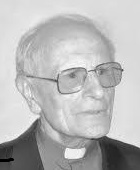
F X Durrwell’s account of our salvation through the risen Christ in his Church
Durrwell’s Life
François-Xavier Durrwell was born in Alsace (then part of Germany) in 1912. He was educated by the Redemptorists and joined that order when he was nineteen, and was ordained priest five years later, in 1936. He spent almost all his life within the Redemptorist congregation in Alsace, including nine years as provincial superior, and died there in October 2005.
His Writing
In 1950 he published his first and most widely-read book, La résurrection de Jésus, mystère de salut, in English The Resurrection, which went through 11 French editions and was translated into many languages. It was subtitled, ‘a biblical study’, and contains a very full scriptural analysis of his theological ideas. He subsequently wrote 16 other books on various theological themes, such as the apostolate, the Eucharist, the Holy Spirit, and Mary; but they were all developments of the central idea of The Resurrection. In 2001, he tried to bring all the threads of his theology together in ‘Christ Our Passover’, shortly before his death.
Rejection of ‘juridical theologies’
There has long been a strand of theological thinking in both the Catholic and the protestant churches which, with some variations, runs essentially as follows. Mankind’s sins offended against the goodness of God, and divine justice demanded an adequate reparation. Since no sinful human being could provide the infinite reparation needed, God sent his only Son to suffer and die, in order that mankind could be bought back (‘redeemed’) from the slavery of sin. In one version (known as ‘the theology of substitution’), by taking flesh Jesus became a substitute for sinful humanity, bringing on himself the wrath of God that rightly should fall on us for our sins, and himself descending into the hell of abandonment and rejection by God. When the price of redemption had finally been paid by Jesus’ death, and human beings had thereby been reconciled to God, God pardoned mankind and raised Christ from the dead to demonstrate his power to save. The merits won by Christ’s death are now applied to us, who do not deserve them, and by this means we share in Christ’s death and will share in his Resurrection.
Durrwell rejected this type of theology as appallingly wrong. It is appalling for its portrayal of God, not as a Father with an infinite love of his creation, so much as an impersonal justice that demands its rights. The substitution theory seems to pit the Father against the Son in an adversarial relationship. Jesus is like a hostage for whose release the Father demands ransom. It is hard to reconcile these images of inner-Trinitarian relations with the absolute unity of a loving God. Durrwell describes these versions of theology as ‘juridical theologies’ because they understand God’s righteousness or justice in the way we humans exercise justice in our disputes. In Durrwell’s understanding, “God’s justice comes from the holiness of God, which is love without boundaries. Justice that is love has as its criteria neither ‘merit’ that must be compensated nor ‘fault’ that must be punished. It is gratuitous. … It was God who paid the great price of redemption, not us. It was God who accomplished the expiation of our sins by sanctifying us human beings in his Son. … A person dead to God cannot come to life again merely because someone else has died in his or her place.”[1]
Jesus’ death and resurrection are a single event
These ‘juridical theologies’ are profoundly wrong also, in Durrwell’s view, because they attribute our redemption wholly to Jesus’ death, and separate that event from his Resurrection, which appears secondary or superfluous. For Durrwell, Jesus’ death and Resurrection are one and the same event. Dying on the cross, Jesus committed himself wholly and irrevocably into his Father’s hands – he ‘died towards the Father’ as Durrwell puts it. And his Father received him as his Son (in biblical language, ‘begot him’), raised him up and glorified him in his death. This glorification is the Resurrection. According to St John’s gospel, as Durrwell reads it, “Jesus’ death is the summit of his ascent to the Father. His glorifying encounter took place at that summit, not beyond it – hence in death. His glorification was an act of eternal fullness: eternal glorification holds Jesus in the death from which glory is inseparable. His glorification is eternal today. His death is also.”[2] (It is important to note that Jesus is dead and stays dead eternally. The Resurrection does not nullify his death, nor snatch back the glory of his obedience to the point of death, by making him live again.)
One of the reasons Jesus’ death and resurrection have been thought of as separate events is the gap of 36 hours or so in the Passion narratives between 3 p.m. on Good Friday, when he died, and early Easter Sunday morning, when the women found the tomb empty, together with Jesus’ prediction that he would rebuild the temple in three days[3] and Paul’s text, which has entered our creed, that ‘Christ was raised on the third day in accordance with the scriptures’[4]. Durrwell offers a number of practical explanations of these apparent contradictions of his thesis, but finally concludes, “The theologically certain unity of the death and resurrection must not be denied simply because it poses a problem for reason”[5].
By his death in glory, Jesus became fully the Son of God (‘today I have begotten you’[6]). God the Father did not adopt him, since he was always destined for that role as we know from the Annunciation to Mary. At his death in glory, he became the Messiah, the Christ, as Peter at Caesarea Philippi and the crowds on Palm Sunday had anticipated, though Jesus had said, right up to Holy Week, that the hour had not yet come for him to be glorified. Therefore his death inaugurated the long-awaited Messianic Age, the Kingdom of God. In his death in glory, Christ became in his own person our redemption: only by sharing in his death (and hence in his glorification, that is, his resurrection) can we win eternal glory, that is, eternal life, ourselves.
The Holy Spirit
Durrwell has a clear and distinctive theology of the Holy Spirit. God is present in the world today as the Holy Spirit. He writes, “The Spirit reveals himself in the world as divine action. He is neither the author nor the effect of the action – he is the action itself.”[7] Durrwell identifies the Spirit of God’s holiness with God’s power and God’s glory. And since God’s power and activity in the world are the power and exercise of love, the Holy Spirit is God’s love. Jesus was born through God’s power, that is, through the Holy Spirit. He was not, of course, the Son of the Holy Spirit but of God the Father, and (as I have already indicated) he was not to achieve the full status of Son of God until his death. When Jesus died, it was through the Holy Spirit that he was raised to the eternal glory of being Son and Christ. St Paul refers to the Holy Spirit as ‘the Spirit of the Son’[8] and ‘the Spirit of Christ’[9], because Christ is eternally God.
Jesus in the flesh was weak – as the hymn in St Paul’s letter to the Philippians says, he “emptied himself to assume the condition of a slave, and became as men are; and being as all men are, he was humbler yet, even to accepting death, death on a cross”[10]. As Jesus had often said[11], it was necessary for him to suffer and to die in order to be glorified. “But God raised him high and gave him the name which is above all other names” (that is, the name of ‘Lord’, by which God himself was known) “so that all beings in the heavens, on the earth and in the underworld should bend the knee at the name of Jesus, and that every tongue should acclaim Jesus Christ as Lord”[12]. And, by pouring out the Holy Spirit into Jesus, God the Father raised him into his own glory and power.
Birth of the Church and the Second Coming
Jesus lived, died and was raised up in order to show human beings how to be free from the slavery of sin and how to live eternally, united with Christ, in the glory of God. When the Holy Spirit was poured out on Christ in his Resurrection, it was immediately poured out through him onto his disciples: on Easter Sunday evening he appeared to them in the Upper Room and “he said to them, ‘Peace be with you. As the Father sent me, so I am sending you’. After saying this, he breathed on them and said, ‘Receive the Holy Spirit’.”[13] This, in Durrwell’s view, was the birth of the Church. As Christ shed his body of flesh on the Cross, he acquired his mystical body, the Church, the community of believers committed to uniting themselves in his death and resurrection. In Durrwell’s theology, Christ’s resurrection is our resurrection also – the day of the Lord, the day of judgement, the so-called Second Coming or Parousia of Christ, when, as St Matthew’s gospel says (quoting the prophecy of Daniel), “all the peoples of the earth … will see the Son of Man coming on the clouds of heaven with power and great glory.”[14] So, a remarkable aspect of Durrwell’s account is that he sees Jesus’ death, his resurrection, the descent of the Holy Spirit on the disciples, the foundation of the Church and the Second Coming as all one event, rather than a sequence stretching from Good Friday through Pentecost to the end of time, as in the conventional view. It would take too long to explain how he derives this view from the scriptures, but he makes the point that “in none of Jesus’ sayings do the resurrection and the second coming appear as separate events.”[15] One consequence of this view is that he sees the language of Christ’s ‘return’ as improper (as in phrases like ‘until he comes again’), since it implies that Christ is absent from this world though promised, and that, by returning to the place of his departure he will nullify the mystery of his death[16].
The salvation of the individual Christian
God so created the universe that human beings (like all living things) are born to die, in the physical sense. Yet God has a horror of the kind of death that ends life and breaks relationships, and he created us in love so that we should have eternal life. When God said to Adam, “in the day you eat of it you shall die”[17], he was referring to this sort of death, not to physical death. Therefore, in God’s plan, physical death can only be at the service of humanity’s birth as children of God.[18] Durrwell follows St Paul in saying that it is only by dying to the flesh that we can rise again spiritually. We do this to some extent through baptism and the other sacraments, but our definitive encounter with Christ is when we shed the limitations of the flesh in our physical death. That is to say that, if we die in Christ, we will rise again immediately with a spiritual body – there is no period of thousands of years in which a bare soul exists without a body, and we never live again on earth in a body of flesh and blood..
Since God’s justice is love, the last judgement of Christ is an invitation of love. Only by rejecting that love and refusing to be a child of God, can a person condemn himself or herself to be eternally excluded from the goal for which we were created – seeing God face to face in union with Christ. We each make that choice in our earthly life (since we can make no more choices when we are dead). The judgement for eternal life with Christ or for eternal damnation is effectively made now and becomes effective in the moment we die and are resurrected. If we have not in our lives subdued our worldly, carnal appetites through mortification of the flesh and suffering, and built up our spiritual lives, sufficiently to become the wholly loving beings that can see God, but yet we do consent to being purified through further suffering, then the fire of that love (which is the Holy Spirit) will purify us by making us spiritually capable of love. Durrwell suggests we think of purgatory as a time of dying towards the Father, but admits we really have no concept of it.[19]
The Church
Christ was sent to bring salvation to the world, indeed to become in himself our salvation. ‘As the Father has sent me, so I send you.’[20] As Christ’s body on earth, the Church and everyone in it is sent and has a share in the great salvation event. Durrwell writes, “The Church adds nothing to the mystery of salvation, it does not complete it, and it is not a second act. The Church participates in everything through its role in the unique redemptive action of Christ. What Christ is, what he says and does, the Church is also saying or doing in complete deference to Christ, in a communion that identifies the Church with Christ, who is the unique and universal mediator by his [death and resurrection].”[21]
Christ gave the Church a number of instruments to carry out the work of salvation in the world: firstly, the Apostles, among which St Paul counted himself, witnesses to the Resurrection, preaching and bringing the death and resurrection of Christ to the entire world; secondly, the sacrament of the Word, the proclamation of the gospel, which accomplishes what it proclaims in those who accept it; and thirdly, the seven sacraments of the Church, especially baptism and the Eucharist, both intimately linked to Christ’s death and Resurrection in Durrwell’s account. ‘The Eucharist brings the fullness of Christ’s sacrifice into his earthly body, the Church, in whom the sacrifice is still not complete; and it draws her towards that fullness, for it makes all men together the one body of Christ, dead and risen, so that those who are fed by it are also offered in sacrifice.)[22]
As the Church works in the world to extend salvation to everyone, the Church itself is gradually being perfected, eventually to become wholly spiritual and wholly incorporated in Christ. Meanwhile on earth the Church is faithful to itself to the extent it seeks to adapt itself to its heavenly truth. Durrwell has written, “Through our communion in the Holy Spirit, the members of the Church are all equal…. All share the same grace and dignity, the same power of the Holy Spirit. Therefore in communion one does not find either superiors or inferiors – all are members of the body of Christ animated by the Holy Spirit…. [But] on earth the Church is also an organized society – it is an institution…. How can one bring together this Church that is a mystery of communion rooted in equality with an institution where superiors exercise authority? Two approaches to the Church are possible, depending on whether one gives priority to the institution or to the mystery of communion.”[23] Durrwell rejects the first approach (giving priority to the institution) as typical of the ‘juridical theology’ he has earlier condemned; he accepts an authority based on ministry. For example, for everyone to celebrate the Eucharist, some one person has to preside, and the Church has conferred that ministry on the ordained priest. Anyone who would try to preside at the Eucharist by deliberately putting himself apart from the rest of the Church would have no power to consecrate the bread and wine. But that ministry does not raise him above the rest of the faithful nor does he exercise power over the assembly. “Whoever would exercise power over the Church, a power of domination, would be in error about the nature of authority. He would commit a sin similar to someone who would use the Eucharist as an ordinary meal without discerning the body of Christ.”[24] Durrwell concludes, “We can expect in the future that the theology of redemption will be free from juridical moulds. We hope that an ecclesiology based on a theology of redemption will move on from ways of thinking and practice dominated by the delegation of powers and jurisdiction toward one where communion with Christ in the Holy Spirit prevails. The Church is unceasingly invited to that kind of conversion.”[25]
A cursory study of Church history reveals many occasions in which high officials of the Church, wielding great temporal power, have done immense evil to other people or to the Church itself, through stupidity, personal wickedness or corrupt cultures. There are conscientious Catholics who believe that the institutional Church today, by the behaviour of some of its hierarchy, by some of its teachings, or by aspects of its liturgies, is driving sincere followers of Christ away from the sacraments that they need in order to grow in faith and unity with him. The question arises, ‘What, if anything, should lay Catholics do to correct the defects in the Church?’
Durrwell does not address this question directly, but he says two or three things that might be relevant to answering it. In an early book on the spiritual life of the individual, he stresses the value of Christian obedience, saying, “The Church’s institutions may be a cross we have to bear, but whoever takes it up, that cross is Christ’s, ‘in which is salvation, life and resurrection’. The Church is established on earth to lead men to the consummation of the Last Day…. She does this by the kind of precepts she imposes and by the fact of imposing them. How strange is the error of thinking that to disobey them is progress!”[26]
In his book Christ Our Passover, he has a short section on Christian ethics, which gives absolute primacy to the law of the Spirit: “As Christians… we must follow the law in our own heart. We are not to perform deeds because they are commanded by God. We must follow the law of our own being and do what we like.”[27] But he points out, “All this finds its ultimate truth only in fellowship, or communion, with the Son….The degree of freedom for any Christian is in proportion to his or her life in the Spirit. On earth, a Christian is still largely dependent on the flesh…. To the extent that a Christian is not yet submissive to the law of freedom, that person is bound by multiple written laws contained in Scripture, … [and] subject to laws written by the Creator in human nature. Paul … still demanded submission to the civil power, insofar as it conformed to God’s authority[, and he] imposed on his communities rules of a canonical order, ‘laid down not for the innocent person but for the lawless and disobedient’[28], for those who do not yet live entirely by the Spirit…. To sum up: the basis of Christian ethics is liberty from written laws external to the person. Yet we are still subject to such laws. But the law of love and freedom must be primary. The others are relative. They are at the service of love and freedom, subordinated to the good of the person in his or her relationship to God and neighbour.”[29]
Notes:
[1] Christ Our Passover, pp 55-56.
[2] Christ Our Passover, p 53.
[3] Jn 2: 19.
[4] 1 Cor 15: 4.
[5] Christ Our Passover, p 36.
[6] Acts 13: 33; Heb 1: 5, 5: 5; all quoting Ps 2: 7 (NRSV translation)
[7] Christ Our Passover, p 154.
[8] Gal 4: 6.
[9] Rom 8: 9.
[10] Phil 2: 7-8.
[11] Mt 16: 21 = Mk 8: 31 = Lk 9: 22; Mt 17: 22-3 = Mk 9: 21 = Lk 9: 44; Mt 20: 17-8 = Mk 10: 23-4 = Lk 18: 31-3; Jn 3: 14.
[12] Phil 2: 9-11.
[13] Jn 20: 21-2.
[14] Mt 24: 30 (=Mk 13: 26 =Lk 21: 27), quoting Dn 7: 13.
[15] Christ Our Passover, p 64.
[16] Christ Our Passover, footnote 114, pp 181-2.
[17] Gen 2: 17.
[18] cf Christ Our Passover, pp 137-8.
[19] cf Christ Our Passover, pp 140-2.
[20] Jn 20: 21.
[21] Christ Our Passover, pp 107-8.
[22] The Resurrection, p328.
[23] Christ Our Passover, p 100.
[24] Christ Our Passover, p 103.
[25] Christ Our Passover, p 104.
[26] In the Redeeming Christ, p 207. (A first version of this chapter appeared as Sainteté chrétienne, sainteté d’obéissance in La Vie Spirituelle 95 (1956), pp 259-270.)
[27] Christ Our Passover, p 95.
[28] 1 Tim 1: 9.
[29] Christ Our Passover, pp 96-7.
Select Bibliography
Books by F-X Durrwell C.Ss.R.
The Resurrection – A Biblical Study, tr Rosemary Sheed (New York, Sheed and Ward, 1960 – translated from the 2nd edition of La résurrection de Jésus, mystère de salut, 1950): the starting point of Durrwell’s insights, relatively free of technical jargon but packed with references to passages of scripture, which make for slow reading.
In the Redeeming Christ, tr Rosemary Sheed (London and New York, Sheed and Ward, 1963 – from Dans le Christ rédempteur, 1960): a collection of papers applying the principles of Durrwell’s first book to the individual’s spiritual life, designed for a less specialized readership.
Christ Our Passover – The Indispensable Role of Resurrection in Our Salvation, tr J F Craghan (Chawton, Hampshire, Redemptorist Publications, 2004 – from Christ notre Pâque, 2001): a fairly short synthesis of his theology, bringing together elements from his previous books.
Books about Durrwell
These, the only book-length studies of Durrwell’s theology that I know of, have not yet been translated into English.
La sotériologie de François-Xavier Durrwell – Exposé et réflexions critiques by Jules Mimeault (Rome, Editrice Pontificia Università Gregoriana, 1997), in French.
François-Xavier Durrwell, teologo della Pasqua di Cristo by Réal Tremblay (Vatican City, Lateran University Press, 2010), in Italian.
 Goodness Gracious